Radon products span a wide price range. Here’s where the extra cost of premium options actually buys something meaningful, and where it doesn’t.
The useful way to think about this is that the three product categories involved are not one market with a price ladder. A test kit is a consumable whose accuracy depends mostly on a laboratory you never see. A continuous monitor is an instrument you keep for years. A mitigation fan is a piece of continuous duty equipment that runs every hour of every day for its entire life. Those are different economic propositions, and the answer to whether the premium tier is worth paying for is genuinely different in each.
- Test kit accuracy differs less by price than by certification (EPA-listed/NRPP-approved).
- Continuous monitor price differences correlate more meaningfully with verified accuracy and features.
- Premium mitigation fans typically offer longer warranties and better reliability for continuous operation.
- Certification matters more than price tier for one-time test kits.
Test Kits: Modest Difference
Both budget ($15) and premium ($30+) short-term test kits, if EPA-listed or NRPP-approved, provide comparable core accuracy — the premium price often reflects faster lab turnaround or a nicer physical device rather than fundamentally better measurement.
The reason the spread is narrow here is that a passive test kit is mostly a piece of physical chemistry with very little to differentiate. A short term charcoal kit is activated carbon in a container that adsorbs radon over the exposure period and is then sealed and posted to a laboratory, where the decay products are counted. A long term alpha track detector is a small piece of plastic film inside a filtered chamber, where alpha particles from radon decay leave physical damage tracks that are chemically etched and counted under magnification. Neither device contains electronics, and neither has much scope for a manufacturer to add accuracy through better engineering.
What you are actually paying for at the higher end is the laboratory and the paperwork. The differences worth checking are whether the analysing lab participates in a recognised proficiency programme, whether the price includes laboratory analysis and return postage or charges them separately, how quickly results are returned, and whether the report gives you the supporting detail. Charcoal kits also have a real shelf life consideration, since the exposure period must fall within the window the lab specifies, and a cheap kit bought long in advance and left in a drawer is a false economy. Check the expiry date before you deploy it, not after.
The bigger accuracy factor is following placement and closed-house instructions correctly, not the specific kit price point, as long as it carries proper certification.
Continuous Monitors: More Meaningful Differences
Budget continuous monitors ($80-$120) sometimes lack independent EPA listing or third-party accuracy verification, while premium monitors ($150-$250) more consistently carry verified accuracy credentials and better app integration, alerting, and data logging features.
This is the category where the price ladder buys something measurable, and the underlying reason is detection physics. Consumer continuous monitors generally work either by ionisation chamber or by alpha spectrometry, and the practical difference shows up as how long the device needs before its reading becomes statistically stable. Radon decay is a random process, so a monitor is effectively counting events, and a device with a larger detection chamber or a more selective counting method accumulates a usable sample faster. That is why one monitor can offer a meaningful short term reading within hours while another needs a day or more before the number stops moving.
The features that matter over years of ownership are less glamorous than the specification sheet suggests. Look for whether the device stores and exports a history you can actually read, since the value of a continuous monitor is in the trend rather than in today’s number, and a monitor that only shows a rolling average on a small screen gives you far less. Check whether it needs periodic recalibration and what that costs, because a monitor that has drifted is worse than no monitor at all. Check the power arrangement too: a battery unit you can move room to room answers different questions than a mains powered one that sits permanently in a finished basement.
For a device you’re relying on for ongoing monitoring rather than a one-time test, the premium tier’s verified accuracy is a more meaningful difference than with disposable short-term kits.
Mitigation Fans: Reliability Matters More
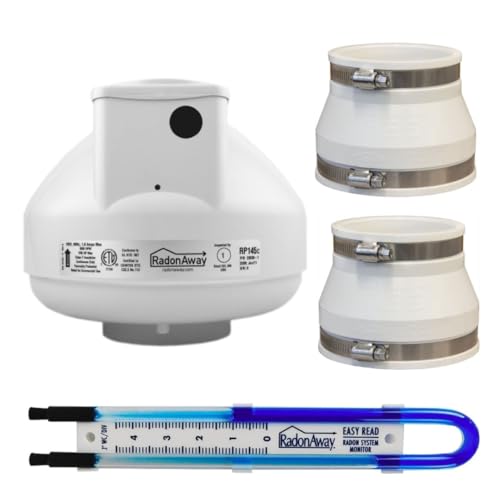
Budget fans may have shorter warranty periods and lower CFM ratings that could underperform on larger foundations, while premium radon-rated fans typically carry longer manufacturer warranties (5+ years) and are rated for a wider range of foundation sizes.
A radon fan is the one component in this whole subject that never switches off. It runs continuously from the day it is commissioned, which means it accumulates operating hours at a rate no other appliance in a house approaches. That single fact reframes the price comparison. The purchase price difference between tiers is small relative to the cost of the labour to replace a failed unit, and it is very small relative to the cost of the exposure that accrues during however many months pass between the fan failing and someone noticing.
The specification that actually matters is not headline power but the match between the fan curve and your soil. Tight, clay heavy soil requires a fan that develops high static pressure at low airflow, because the resistance to drawing air through that material is high. Loose gravel or a proper aggregate layer under the slab wants the opposite, a fan that moves higher volume against low resistance. A powerful fan of the wrong type performs worse than a modest fan of the right one, and it will also consume more electricity and generate more noise doing it. Other things worth weighing are the sealed housing rating for exterior mounting, the warranty term, and the noise specification, since a fan mounted near a bedroom wall is one people switch off.

Given a fan runs continuously for years, the premium tier’s longer warranty and proven reliability track record is often worth the moderate price difference.
The Running Cost Nobody Prices In
Because the fan runs continuously, its electricity consumption is a real recurring cost rather than a rounding error, and it is the part of the comparison most buyers never calculate. A fan drawing a modest continuous load runs for roughly eight thousand seven hundred hours a year, so the annual energy cost is straightforward arithmetic once you know the wattage and your electricity rate. Multiply the wattage by hours, divide by a thousand for kilowatt hours, and multiply by your rate. It is worth doing this comparison across the specific models you are considering rather than assuming the difference is negligible, because over the service life of a system the gap between an efficient and an inefficient fan can approach the purchase price difference.
There is a second and larger energy cost that is easy to miss. An active sub slab system continuously exhausts air from beneath the slab, and in a leaky house some conditioned indoor air follows that path. The way to keep this small is not to underspecify the fan but to seal the slab properly, because good sealing at cracks, the slab to wall joint, sump lids, and any open floor drains lets the system draw predominantly from the soil rather than from your heated living space. Sealing is usually described as a supporting measure to depressurization, and this is one of the concrete reasons why: it makes the system both more effective and cheaper to run.
Set against that, the premium tier earns its money in a way that does not appear on a spec sheet at all. Fan failure is silent. There is no alarm, no smell, and no change you would notice in daily life, so a failed fan is discovered either at the next manometer check or at the next test, and the exposure in the interval is unmeasured. This is why a fan failure alarm and a manometer are disproportionately valuable accessories on any tier of system, and why reliability rather than raw performance is the specification most worth paying up for here.
FAQ
Is a premium radon test kit meaningfully more accurate than a budget one?
Not necessarily, if both are EPA-listed or NRPP-approved. The premium price often reflects other features (turnaround speed, device design) rather than core measurement accuracy.
Is a more expensive test kit more accurate?
Usually not in any way you would notice. The measurement is performed by the laboratory rather than by the device, so what matters is whether that laboratory participates in a recognised proficiency programme and whether the kit is being used within its stated exposure window and shelf life. A correctly deployed inexpensive kit analysed by a proficient lab is a sound measurement. Where price does buy something is in turnaround time, included analysis and postage, and the level of detail in the report.
Do I need a continuous monitor if I have already tested with a kit?
They answer different questions. A kit gives you a single integrated average over its exposure period, which is what you need for a screening decision or a transaction. A continuous monitor shows you how the level moves day to day and season to season, which is what tells you whether your result was taken during a typical week or an unusual one, and whether a mitigation system is still holding. If you have mitigated, a monitor is the fastest way to notice a fan failure. If you tested once at a low level and nothing about the house has changed, it is a convenience rather than a necessity.
Will a more powerful mitigation fan lower my radon further?
Not reliably, and it can make things worse. The goal is to establish a suction field that extends across the whole slab, and that depends on matching the fan characteristics to the permeability of the material underneath. An oversized fan on tight soil mostly pulls conditioned air down through gaps in the slab rather than extending the field, which raises your heating and cooling costs and your electricity use without improving coverage. Where a single suction point genuinely cannot reach the whole slab, the answer is an additional suction point rather than a bigger fan.
Always verify EPA listing or NRPP approval regardless of price tier — this matters more than the budget-vs-premium distinction itself.
These statements have not been evaluated by the Food and Drug Administration. This information is not intended to diagnose, treat, cure, or prevent any disease. Content is for informational purposes only and is not medical advice; consult a qualified healthcare provider before starting any supplement. As an Amazon Associate we earn from qualifying purchases.
