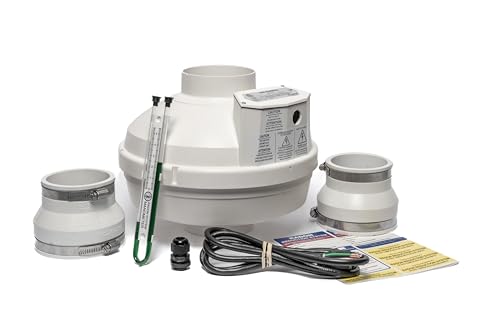
Some homeowners wonder whether combining multiple mitigation approaches gives better results than a single method alone. The answer depends on which methods you’re combining.
The instinct that more methods should produce a better result comes from thinking about radon as a quantity to be removed, when the mechanism is actually about pressure. Radon enters a house because the pressure under the slab is higher than the pressure inside the building, so soil gas flows in through every available opening. Active soil depressurization does not filter or neutralise anything; it reverses that pressure relationship so the flow goes into a pipe and out above the roof instead of into the house. Once you understand it as a pressure problem, it becomes clear why some additions to the system genuinely help and why others contribute almost nothing.
- ASD already addresses most secondary leak pathways by creating broad negative pressure.
- Sealing alone is not adequate mitigation on its own — it’s supplementary to ASD, not a substitute.
- General ventilation adds marginal radon benefit on top of a working ASD system.
- Multiple ASD suction points (not combining different method types) is the right approach for complex foundations.
ASD Plus Sealing: Usually Redundant but Not Harmful
Active sub-slab depressurization (ASD) already addresses the primary entry pathway by creating negative pressure beneath the slab, which naturally reduces the driving force pulling radon through smaller cracks too. Additional sealing of visible cracks is a reasonable belt-and-suspenders step but generally isn’t necessary for ASD to work as designed.
Sealing on its own is not a reliable fix, and this is one of the clearer positions in the guidance rather than a matter of opinion. The reason is that a slab has far more openings than the visible ones. Beyond obvious cracks there is the perimeter joint where slab meets foundation wall, the annular gaps around every plumbing and conduit penetration, open floor drains, sump pits, and the porosity of the concrete itself. Sealing what you can see leaves the rest, and because the pressure difference driving entry is unchanged, soil gas simply redistributes to the remaining paths. Measured results from sealing alone are inconsistent, which is why it is described as a supporting measure rather than a standalone method.
Combined with an active system, though, sealing does real and specific work, and calling it redundant undersells it. Its function changes: rather than blocking radon, it stops the fan from drawing conditioned indoor air down through slab openings and out of the building. That has three consequences worth having. The suction field extends further across the slab for the same fan, because the air the fan moves is coming from the soil rather than short circuiting through the floor. Heating and cooling losses drop. And the fan can often be a smaller, quieter, cheaper to run unit than it would otherwise need to be. The highest value targets are the sump pit lid, open floor drains, the slab to wall joint, and the gaps around penetrations.
Sealing alone, without a fan-driven system, is explicitly not considered adequate mitigation by the EPA for elevated levels — it’s a supplementary measure, not a substitute for ASD.

ASD Plus Ventilation: Marginal Additional Benefit
Adding general home ventilation (HRV, exhaust fans) on top of a working ASD system provides only marginal additional radon reduction, since ASD is already addressing the source. Ventilation’s main value is for general indoor air quality (humidity, VOCs), not as a primary radon strategy layered on top of mitigation.
Increasing ventilation does lower indoor radon by dilution, and in a house with no mitigation system it can produce a measurable reduction. The difficulty is that it works against the concentration rather than against the entry, so it has to run continuously to hold the benefit, it carries an ongoing energy penalty in any climate with a real heating or cooling season, and it is at the mercy of occupant behaviour and weather. It also has an awkward interaction worth understanding: exhaust only ventilation lowers the pressure inside the house, which increases the pressure difference across the slab and can increase the rate at which soil gas is drawn in. A balanced system that supplies and exhausts equal volumes avoids that problem, while an unbalanced exhaust fan can partly undo its own benefit.
Once an active system is working properly, the ventilation contribution becomes small, because the soil gas is being intercepted before it enters rather than diluted after it arrives. The place where ventilation still earns its keep is where depressurization is difficult or impossible to apply: a basement whose slab has been repeatedly cut and patched, a house sitting on rock or highly variable fill where the suction field will not extend, or a structure with no slab to depressurize at all. In those situations, and in some crawlspaces, ventilation moves from being an optional supplement to being the practical primary approach.
Running both together does increase energy costs somewhat, so it’s worth evaluating whether the marginal radon benefit justifies the added ventilation running continuously.
When Multiple Suction Points Are the Right Combination
For homes with mixed foundation types or unusually large footprints, combining multiple ASD suction points (rather than combining ASD with a different method entirely) is often the correct approach — this is different from combining fundamentally different mitigation strategies.
The combination that genuinely improves results is more suction points rather than more methods, and the reason is geometric. A single suction point creates a low pressure field that spreads outward through the material beneath the slab, and how far it spreads depends on how permeable that material is. Clean aggregate carries a field a long way. Compacted clay, fine sand, or disturbed fill carries it a short distance. If the field does not reach the far corner of the slab, that corner is unmitigated no matter how much suction is applied at the pipe, because there is no path for the pressure to propagate along.
Deciding this is a measurement rather than a judgement call, and the measurement is a sub slab communication or pressure field extension test. It involves drilling small test holes at various distances from the proposed suction point, applying suction, and measuring the pressure change at each hole with a micromanometer. Where the field falls away below the threshold, an additional suction point is needed. Certain foundation configurations almost always require more than one: a house with a slab and a separate crawlspace, an addition poured on its own footing with a foundation wall between it and the original slab, a split level with independent slabs at different depths, or any structure where an interior footing divides the sub slab space into compartments that do not communicate with each other.

Diagnose Before You Add
When a system underperforms, the productive response is to find out why before adding to it, because the same symptom of a still elevated post mitigation reading has several distinct causes and they call for opposite responses. Start with the manometer, which tells you immediately whether the system is generating suction at all. A reading at or near zero points to a stopped fan, a blocked or collapsed pipe, a disconnected suction point, or a sensing tube problem, none of which are solved by adding a second method.
If the system is holding suction but the level is still high, the question becomes whether the suction field reaches the whole slab. That is answered by the same pressure field extension test used at design time: test holes at the far reaches of the slab, suction applied, pressure measured. If the field is not reaching, the answer is another suction point. If the field is reaching everywhere and the level is still elevated, then something is entering by a route the sub slab system does not control, which brings a short list of candidates into view.
Those candidates are worth checking in order because they are commonly missed. An unsealed or open sump pit is a large direct opening between the sub slab space and the room. An untrapped or dry floor drain is another. An adjoining crawlspace with exposed soil is effectively an unmitigated entry area sitting next to a mitigated one. And where a home is on a private well, radon dissolved in groundwater is released into indoor air whenever water is agitated by showering, laundry, or dishwashing, and no amount of sub slab work addresses that. Waterborne radon is generally treated separately, with aeration or granular activated carbon at the point of entry. Each of these has its own remedy, and each would be missed by simply adding another layer to a system that is already doing its job correctly.
FAQ
Is sealing cracks enough to fix a radon problem without a fan system?
No. The EPA doesn’t consider sealing alone adequate mitigation for elevated levels — it can supplement an active system but isn’t a substitute for it.
Is sealing cracks enough to fix a radon problem on its own?
Generally no, and this is a well established position rather than a cautious one. Sealing alone has not been shown to lower radon levels consistently, because a slab has many more openings than the visible cracks, including the perimeter joint, penetration gaps, floor drains, sump pits, and the concrete itself. Since the pressure difference driving entry is unchanged, soil gas redistributes to whatever paths remain. Sealing is valuable as a companion to an active system, where it improves suction field extension and cuts conditioned air loss.
Will adding a second fan lower my radon further?
Usually the more effective change is an additional suction point rather than a second fan on the same pipe. If the suction field does not extend across the whole slab, the limiting factor is the permeability of the material underneath, and more suction at one location does not push the field much further. A new suction point in the underserved area addresses the actual constraint. Independent fans do make sense where a house has genuinely separate sub slab areas that do not communicate, such as a slab plus a crawlspace or an addition on its own footing.
Do I still need to seal if I have an active system installed?
It is worth doing, though the reason changes. With an active system running, sealing is not what keeps radon out, since the fan is doing that. Its role is to stop the fan drawing conditioned indoor air down through slab openings, which lets the suction field extend further for the same fan, reduces heating and cooling losses, and can allow a smaller and quieter fan. The targets that matter most are the sump lid, open floor drains, the slab to wall joint, and gaps around pipe and conduit penetrations.
For elevated readings, active sub-slab depressurization remains the EPA’s recommended primary method — treat other approaches as supplementary, not standalone fixes.
These statements have not been evaluated by the Food and Drug Administration. This information is not intended to diagnose, treat, cure, or prevent any disease. Content is for informational purposes only and is not medical advice; consult a qualified healthcare provider before starting any supplement. As an Amazon Associate we earn from qualifying purchases.