A few accessories genuinely improve a radon mitigation system’s reliability or your ability to monitor it, beyond the core components.
What separates a worthwhile radon accessory from a decorative one is whether it addresses the specific failure mode this equipment has, which is silence. A radon mitigation system that stops working produces no sound, no smell, no change in comfort, and no visible sign. The house feels identical. Everything genuinely useful in this category exists to convert that silent failure into something a person will notice, and accessories that do not serve that purpose are competing for attention with a manometer that costs a fraction as much and does it better.
- A fan failure alarm closes the detection gap between failure and your next scheduled retest.
- Use a radon-specific weatherproof exhaust cover, not a generic cap that could restrict airflow.
- A digital manometer display makes quick status checks easier and more likely to happen.
- These accessories improve monitoring convenience without changing the core mitigation approach.
Fan Failure Alarms
If your fan doesn’t already include a built-in pressure-loss alarm, an add-on alarm that alerts you to fan failure closes a meaningful gap — without one, a failed fan can go unnoticed for months until your next scheduled retest.
A fan failure alarm improves on a manometer in one specific respect, which is that it removes the requirement for a person to remember to look. The manometer is an excellent indicator and a poor notifier: it displays the truth continuously and tells nobody. Between one annual inspection and the next there are potentially many months during which a stopped fan goes undetected, and every one of those months is unmeasured exposure in a house that was known to need mitigation. An alarm compresses that window from months to days.
The distinction worth understanding when choosing one is what the device is actually sensing. Some alarms monitor electrical current to the fan, which detects a fan that has lost power or seized but will happily report normal operation on a fan that is spinning while the pipe below it is blocked. Others sense pressure in the vent pipe directly, which catches both the fan failure and the blockage, and is the more complete measurement. Also worth checking is whether the alert is local only or can notify remotely, since a device that beeps quietly in an attic where the fan is mounted is not much of an improvement over the manometer nobody looks at.
Weatherproof Exhaust Covers
A properly designed exhaust termination cover prevents rain and debris intrusion at the roofline or wall exit point without restricting airflow — a generic cap not designed for radon exhaust venting can restrict flow and reduce system effectiveness.
The exhaust termination is a genuine failure point, and the reason is that a radon vent is an open pipe rising above the roofline in a location that birds and wasps find appealing. A nest, an accumulation of leaves, or an ice cap in a hard winter restricts flow, and because the fan continues to run and draw current, nothing about the system’s behaviour changes in a way anyone would notice. Suction at the pipe may drop, which is precisely why the manometer reading rather than the running fan is the meaningful check.
Anything fitted to the termination has to satisfy a constraint that rules out a good deal of general purpose hardware: it must not meaningfully restrict airflow, and it must not redirect the exhaust downward toward the roof or toward any opening. Radon vent terminations are required to discharge above the roof surface and away from windows and other openings by a specified distance, and a cap that turns the discharge sideways or down can undo that. Standard plumbing vent caps and rain hoods are not automatically appropriate for this reason. What is generally acceptable is an open mesh guard with a wide enough aperture to resist blockage, and it becomes another item to look at during the annual inspection rather than a fit and forget solution.
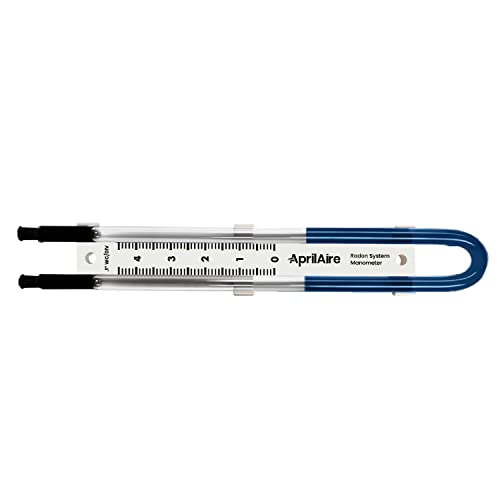
Digital Manometer Displays
While a basic U-tube manometer works fine, a digital display version makes checking system status faster and easier to read at a glance, which can encourage more frequent informal checks between scheduled retests.
A digital gauge offers real advantages over the fluid U tube in readability and precision, and in some models the ability to log readings or transmit them. If the fan riser sits in a dark attic corner or somewhere awkward to reach, being able to read a lit numeric display, or better still read it from elsewhere, meaningfully increases the chance the check actually happens. Logging adds something the U tube cannot provide at all, which is a record of when performance changed rather than only the fact that it has.
Set against that, the fluid manometer has one property that is difficult to beat: it has no power source, no electronics, and no failure mode of its own beyond fluid loss, which is visible. A digital gauge introduces a component that can fail, and a failed gauge on a working system produces a false alarm while a failed gauge that reads plausibly can mask a real problem. The arrangement many people settle on is to keep the U tube as the ground truth and add a digital or connected gauge for convenience and logging, which costs very little and means the two can be checked against each other.

Accessories That Are Not Worth Buying
The clearest example is a general purpose air purifier sold as a radon solution. Filtration can capture some of the particle bound decay products in the air it processes, but it does not remove radon gas and does nothing about the continuous entry of new radon from the soil, so fresh decay products keep forming throughout the room. The established remedy is sub slab depressurization, which intercepts soil gas before it enters and vents it above the roof, and its effect can be verified by retesting. A purifier can be a reasonable purchase for particulates or odours on its own merits, but it should not be counted as radon mitigation.
Charcoal bags, gels, and passive absorbers marketed for radon fall into a similar category. Activated carbon does adsorb radon, which is exactly why a charcoal test kit works, but the quantity involved in a room sized product bears no relation to the volume of soil gas continuously entering a house, and there is no established evidence of a useful reduction in indoor concentration. The activated carbon that does play a real role sits in a very different application: granular activated carbon treatment at the point of entry for a private well, where radon dissolved in groundwater is being removed from the water supply rather than from room air.
Two further categories are worth being careful with. Consumer radon detectors that do not identify their detection method or state a measurement uncertainty are difficult to place any confidence in, and the absence of that information is itself informative. And any accessory that alters the vent pipe or its termination geometry should be checked against the installation requirements before fitting, since termination height and clearance from openings exist for a reason and a well intentioned cap or extension can put a compliant system out of compliance. If in doubt, the person who installed the system is the right person to ask before modifying it.
FAQ
Is a fan failure alarm worth adding if my fan doesn’t already have one?
Yes, generally — it closes a real gap in detecting fan failure between scheduled retests, which could otherwise go unnoticed for months.
Is a fan failure alarm worth adding if the fan is working fine?
The case for it does not depend on whether the fan is working now, since fans run continuously and eventually stop, and the failure gives no outward sign. Without an alarm, the discovery point is whenever someone next checks the manometer, which for most households means at some point within the following year. An alarm reduces that gap to days. Pressure sensing alarms are the more useful type because they also catch a blocked or disconnected pipe on a fan that is still spinning normally.
Can I put a rain cap on my radon vent pipe?
Only with care, because radon vent terminations have requirements about discharging above the roof surface and maintaining distance from windows and other openings, and a cap that deflects the exhaust downward or sideways can compromise that. Standard plumbing vent caps are not automatically suitable. An open mesh guard with a wide aperture is generally the safer choice where the concern is nesting birds or debris, and the termination is worth inspecting annually regardless of what is fitted. Check with your installer before modifying the pipe.
Do I need a manometer if I already have a continuous radon monitor?
They tell you different things and neither substitutes for the other. The monitor measures what is in the room, which is the outcome you care about, but it reports a rise after it has already happened and cannot tell you why. The manometer measures whether the system is generating suction, which identifies the cause directly and immediately. A monitor showing a slow climb plus a manometer showing level columns is a diagnosis rather than a symptom, and manometers cost little enough that having both is the sensible arrangement.
Accessories improve monitoring and reliability but don’t substitute for the core system components and proper installation.
These statements have not been evaluated by the Food and Drug Administration. This information is not intended to diagnose, treat, cure, or prevent any disease. Content is for informational purposes only and is not medical advice; consult a qualified healthcare provider before starting any supplement. As an Amazon Associate we earn from qualifying purchases.
